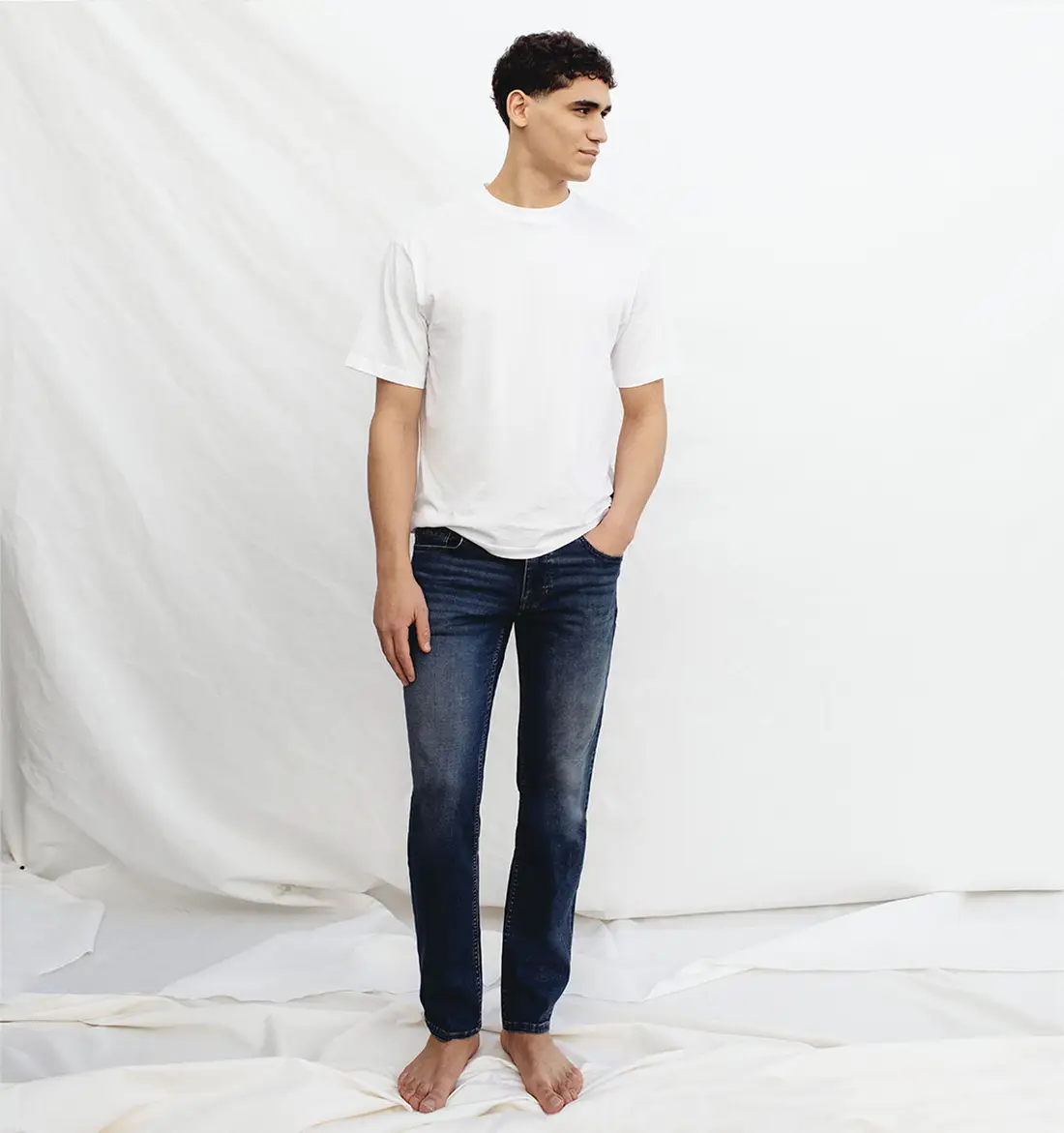
Our aim is to produce jeans with a lower environmental impact – from the choice of fibres and the dyeing of yarns to the washing processes.
To achieve this, we focus on three pillars: preferred fibres, more resource-efficient dyeing processes and measuring the impact of our washing processes.
Conventional denim production can place a burden on the environment through its high use of water, energy and chemicals. We are therefore working to produce our jeans more resource-efficiently and reduce impacts throughout the various production processes.
Our denim strategy is based on three pillars:
preferred fibres,
more responsible dyeing processes,
measuring and improving washing processes.
For a Marc O’Polo pair of jeans to meet our standards, at least pillar 3 must be fulfilled, meaning that the overall score of the washing processes must be rated as a “low impact process”. The more pillars a product fulfils, the lower its environmental impact can be.
PILLAR 1 – PREFERRED FIBRES
We prioritise fibres that can help reduce the use of virgin raw materials or support a more responsible use of resources. These include certified organic cotton, recycled cotton, TENCEL™ Lyocell and recycled polyester.
Organic cotton
Organic cotton is grown according to the principles of organic farming. No synthetic pesticides, defoliants or synthetic chemical fertilisers are used. The cotton is grown in accordance with the relevant certification standards without genetically modified organisms (GMOs).
Recycled cotton
Our recycled cotton is predominantly made from pre-consumer material. This refers to textile production waste that is returned to the material cycle. In this way, we extend the useful life of fibres that have already been produced.
PILLAR 2 – MORE RESPONSIBLE DYEING PROCESSES
Together with our suppliers, we are working to gradually switch dyeing processes to alternative methods. To this end, we assess and use technologies designed to reduce the use of water, energy and chemicals in selected dyeing processes.
One example is Dry Indigo® by Tejidos Royo. This technology uses no water during the dyeing process, meaning that no dyeing wastewater is generated by this process. According to the available information, it uses 65% less energy and 90% fewer chemicals than conventional dyeing methods.
Using chemicals more responsibly
Together with our suppliers, we gradually assess and use alternative dyeing methods. In doing so, we pay particular attention to their use of water, energy and chemicals in the relevant production process.
Our aim is to avoid the intentional use of substances listed in the ZDHC Manufacturing Restricted Substances List (MRSL) in the production processes covered by it. We therefore require the relevant production partners to comply with and monitor the ZDHC MRSL. The list specifies which chemical substances must not be intentionally used in certain textile production and processing processes.
Pillar 3 – More environmentally responsible washing processes
We measure the impact of our washing processes using Jeanologia®’s EIM v2.0 software (Environmental Impact Measurement), a standardised software assessment tool that evaluates clothing and jeans finishing processes in four key areas:
water consumption,
energy consumption,
chemical impact,
worker health.
Among other things, EIM v2.0 sets strict requirements for the use of potassium permanganate and pumice stones and limits their weighting in the score. Both are used in the denim industry to achieve an authentic used look. This can result in wastewater contaminated with stone dust and chemicals, placing additional strain on wastewater treatment plants and requiring special treatment.
The results are presented using a traffic-light system. For our denim standard, the washing processes assessed must be classified as a “Low Impact Process”. To achieve an authentic look at the same time, we use methods such as:
laser treatments,
ozone washing,
nano-bubble technologies,
more environmentally responsible oxidising agents,
synthetic and reusable stones,
special enzyme washes.
In this way, we are continuously developing our denim production and working to reduce the use of water, energy and chemicals in the relevant processes.